
Marketing insights written specifically for allied health professionals.
The Attune Agency blog covers the marketing topics that matter most to psychologists and allied health providers — practice growth, AHPRA-compliant advertising, referral network building, and the practical strategies that help great practitioners get found by the patients who need them.
All Articles
Why we write about this.
Most allied health providers are not marketers — and they should not have to be. But understanding the landscape you are operating in makes it easier to make good decisions about how you invest in your practice's growth. The Attune Agency blog exists to make allied health marketing more accessible, more legible, and more actionable. We write for practitioners who want to understand what good marketing looks like in their sector — without wading through generic advice that was written for a retail brand or a tech startup. Every article is written by the Attune team. Every piece of advice is grounded in the realities of allied health practice in Australia. And everything is checked against the AHPRA advertising guidelines before it is published.
FEATURED ARTICLES




Referral Networks Aren't Just for Psychologists: A Practical Guide for Physios, OTs, Speech Pathologists and Dietitians
Referral networks aren't just a psychology thing. Here's how physios, OTs, speech pathologists and dietitians can build one that doesn't rely on luck.

Is Your Website Still Working as Hard as Your Practice? 7 Signs It's Time for a Refresh
Most practices built their website once and never touched it again. Here's how to tell if yours has quietly fallen behind — and what to do about it.

The Allied Health Professional's Guide to Social Media Marketing
Social media for allied health professionals is one of the most confusing topics in practice marketing — and the confusion is understandable.
This guide is a plain-English explanation of what social media can — and cannot — do for an allied health practice, which platforms are worth your time, what content actually works, and what the AHPRA guidelines mean for your day-to-day posting decisions

How Allied Health Professionals Can Build a Brand Without Compromising Their Professionalism
In the allied health context, branding is not about being flashy, commercial, or self-promotional. It is about being consistent, credible, and recognisable — ensuring that every point of contact a patient, referrer, or colleague has with your practice creates the same impression.
What Is GAIO and Why Does It Matter for Your Allied Health Practice?
Over the past 12 months, you will have heard increasing references to AI search — the use of tools like ChatGPT, Google Gemini, Perplexity, and Microsoft Copilot to find information rather than traditional search engines. What you may not have heard is GAIO and what it means specifically for allied health practices in Australia. This article explains what GAIO is, how it differs from traditional SEO, and what you need to do so your practice is found and accurately represented when patients and referrers use AI tools to search for practitioners like you.
How to Grow a Private Allied Health Practice: A Practical Guide
Growing a private allied health practice in Australia is not like growing most other small businesses. This guide is a practical overview of what actually moves the needle for allied health practices in private practice in Australia — whether you are a psychologist, physiotherapist, occupational therapist, speech pathologist, or any other registered practitioner building a sustainable clinical business.

What Should a Psychologist's Website Include?
Your website is often the first thing a prospective patient — or a GP considering a referral — encounters about your practice. Before they call you, before they book, before they step through your door, they will almost certainly look at your website. What they find there will determine whether they feel confident enough to make contact. This guide covers what a…
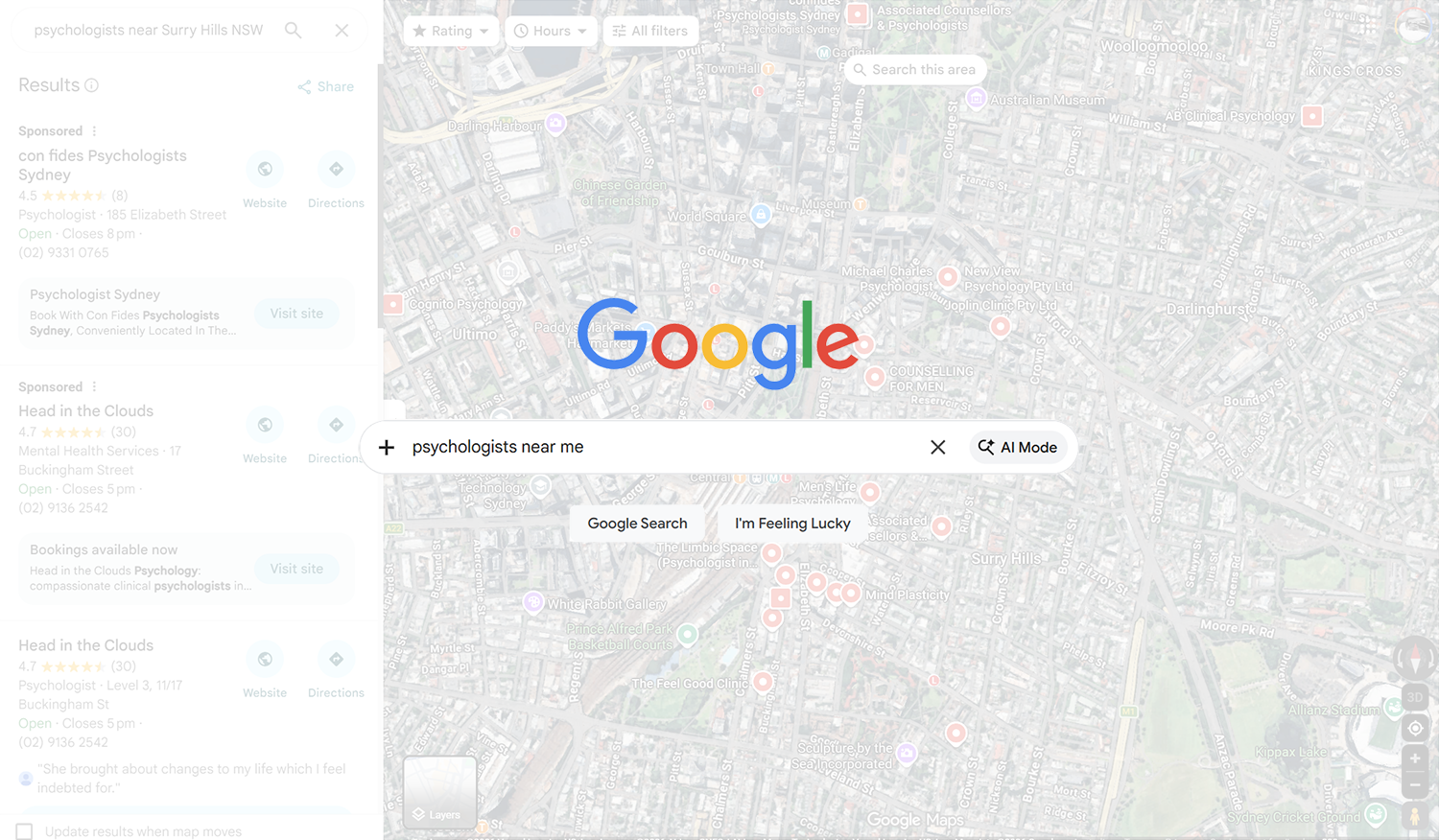
How to Rank on Google for 'Psychologist Near Me'
When a person in your suburb decides they want to see a psychologist, there is a very good chance their first action is to open Google and type 'psychologist near me' or 'psychologist in [suburb]'. In that moment, the practices that appear at the top of the search results…

Marketing for Psychologists: What AHPRA Allows (And Doesn't)
Within the restrictions and advertising guidelines set by AHPRA there is still plenty of room for effective, engaging marketing. This article explains what the AHPRA advertising guidelines actually say, what psychologists can and cannot do, and how to build a compliant marketing presence that still attracts the patients and referrals your practice needs.
How Sydney Psychologists Can Attract More GP Referrals
For most psychologists in private practice in Sydney, GP referrals are not just a nice-to-have — they are the most reliable, highest-quality source of new patients. A patient referred by their GP arrives with trust already established, a clear understanding that they are seeking psychological support, and a higher likelihood of completing a course of treatment.
THE OTHER KIND OF FAQ
FAM — Frequently Annoying Marketing
A candid look at the marketing ideas that sound promising, feel familiar, and consistently underperform for allied health practices. We have seen all of these. We do not recommend any of them.
Most marketing advice is written for retail brands, e-commerce businesses, and tech startups. Apply it to an allied health practice without modification and you will spend real money on things that generate very little. The following are the requests we decline, the tactics we steer clients away from, and the ideas that look compelling on a webinar slide but quietly fail in a regulated health context.
-
AHPRA RED FLAG — Well-intentioned, non-compliant, potentially serious.
Patient testimonials — including Google reviews reproduced on your website — constitute advertising of a regulated health service and are expressly prohibited under AHPRA's advertising guidelines. This applies whether the testimonial is on your website, in a social media post, printed on a flyer, or embedded anywhere else you promote your practice.
The five-star reviews can stay on Google, where patients choose to leave them of their own accord. You simply cannot use them in your own marketing. This is one of the most common compliance errors we see, and one of the most important to correct before it is flagged.
Instead → Describe your approach, your qualifications, and the presentations you work with. Let your expertise speak — compliantly — rather than relying on patient endorsement.
-
WRONG AUDIENCE ENTIRELY — Generates followers. Does not generate patients.
Giveaways attract people who want to win something. In most industries, this is a reasonable trade-off — a percentage of entrants become genuine customers. In allied health, the people entering a giveaway for a free session are rarely the people who will become long-term patients, and the follower count you accumulate is largely disconnected from your actual patient base.
Beyond the strategic mismatch, there are regulatory considerations. Prize draws in Australia must comply with state and territory trading promotion laws, and any promotional activity must still meet AHPRA's advertising guidelines. The combination of compliance overhead and minimal return makes this a poor use of your time and budget.
Instead → Build a following steadily with genuinely useful content written for practitioners and patients who already care about your area of expertise. A smaller, engaged audience is worth considerably more than a large, disinterested one.
-
AHPRA RED FLAG — Not permitted in any form in health advertising.
Before-and-after comparisons are specifically prohibited under AHPRA's advertising guidelines. This includes written case studies, photographs, video content, or any other format that implies a patient achieved a particular outcome as a result of your treatment. It does not matter whether the patient consented, whether names are changed, or how carefully the content is framed.
The prohibition exists because health outcomes are never guaranteed and because comparative claims can create unrealistic expectations in vulnerable people seeking care. It is a line the regulator draws clearly, and it applies to all registered practitioners.
Instead → Describe your areas of clinical expertise and the presentations you are experienced in working with. Explain your approach. Publish educational content that demonstrates your knowledge. These strategies build credibility without touching the prohibited territory.
-
VOLUME OVER VALUE — Exhausting to produce. Rarely examined by patients. GPs do not book referrals via Instagram.
Posting daily requires producing 365 pieces of content per year. For a solo practitioner already carrying a full clinical load, this demand reliably results in one of two outcomes — content quality collapses within six weeks, or the practitioner burns out and stops posting entirely.
Daily posting also assumes that your target audience is engaging with your content every day, which the data does not support for most allied health practices. Your patients are not checking your Instagram feed on a Tuesday morning hoping you have posted something. They are looking for a practitioner when they have a need, and they will find you — or not — based on your search visibility, not your posting frequency.
Instead → Post less often but with genuine purpose. Two or three well-crafted, AHPRA-compliant posts per week on the right platforms will outperform daily filler content every time. Invest the saved time in your website and local SEO, where the return is measurable.
-
AHPRA RED FLAG + JUST NOT TRUE — Outcome guarantees in health advertising are prohibited. And no reputable agency can honestly promise this.
Advertising a regulated health service using claims that guarantee specific outcomes — whether clinical or commercial — is prohibited under AHPRA's guidelines. 'Get more patients' sits in genuinely grey territory. 'Guaranteed results' does not.
Beyond the compliance issue, any marketing agency promising specific patient numbers within a fixed timeframe is either not being honest with you or has no idea how long SEO, referral building, and brand credibility actually take to build. The honest answer is that good marketing for a health practice generates results over three to six months, not thirty days, and the results are influenced by factors that extend well beyond the marketing itself.
Instead → Work with a marketing partner who sets realistic expectations, defines clear KPIs, and reports honestly on what is and is not working. Sustainable practice growth is the goal — not a short-term spike that cannot be maintained.
-
LEGALLY PROBLEMATIC — Against Australian spam law. Also unlikely to work.
Sending unsolicited commercial email to purchased lists is a breach of Australia's Spam Act 2003. The Act requires that recipients have given express or inferred consent to receive marketing communications. A purchased list, by definition, contains neither. Penalties can be significant.
Separate from the legal issue, the practical reality is that GPs receive an extraordinary volume of unsolicited correspondence from practitioners seeking referrals. An unexpected email from a practice they have never encountered, to an address they did not share, is unlikely to build the kind of professional relationship that generates referrals.
Instead → Build GP relationships through a structured, personalised outreach program — introduction letters on quality letterhead, follow-up at appropriate intervals, and communication materials that make referring straightforward. Slower, but far more effective and entirely above board.
-
MISPLACED CONFIDENCE — Social platforms belong to someone else. Your website belongs to you.
Social media platforms change their algorithms, restrict reach, and occasionally shut down. A practice whose entire digital presence exists on Instagram or Facebook has built its foundation on rented land. If the platform changes its rules, reduces organic reach, or charges more for visibility, there is nothing you can do about it.
Your website, by contrast, belongs entirely to you. It is where patients arrive from Google, where your credibility is established in depth, where your contact details live reliably, and where AHPRA-compliant content can be presented in full. It is also the single most important factor in your local search visibility — without a website, you simply do not rank.
Instead → Treat your website as your primary digital asset and social media as a channel that drives people toward it. Own the foundation, rent the distribution.
-
BRAND MISALIGNMENT — Technically possible. Professionally inadvisable.
Trend-driven Reels content works extremely well for consumer lifestyle brands, food businesses, and personal entertainers. For a registered health practitioner trying to be taken seriously by patients in genuine distress and GPs evaluating referral options, it is a different calculation entirely.
The question is not whether you can do it — it is whether the impression it creates is consistent with how you want to be perceived. A psychologist dancing to a trending audio clip might generate views. It is unlikely to generate the specific response you are after, which is a GP trusting you enough to refer their most complex patients, or a person in crisis feeling confident enough to book an initial appointment.
Instead → If video content suits your practice, focus on short, clear, educational clips that demonstrate expertise — answering a common question, explaining an approach, or addressing a misconception. These build credibility rather than just visibility.
-
NOT WRONG, BUT INCOMPLETE — Ads work while you pay for them. SEO works after you stop.
Google Ads are a legitimate and effective marketing channel for allied health practices, and in the right circumstances we recommend them. The limitation is that they are entirely transactional — the moment you stop paying, the traffic stops. There is no residual value, no compounding return, and no authority built over time.
SEO takes longer to build but becomes a compounding asset. A well-optimised page that ranks for 'psychologist near me' in your area continues to generate enquiries without ongoing cost. The two approaches are not mutually exclusive — Google Ads can be a sensible bridge while organic rankings build — but replacing SEO with paid advertising entirely is a decision that costs more in the long run.
Instead → Consider running Google Ads alongside an SEO programme, with the intention of reducing your paid spend as organic rankings improve. Use the data from your Ads campaign to inform your SEO keyword targeting.
-
PROCEED WITH CAUTION — AI-generated content requires expert review in a regulated health context. The risk is in what it gets wrong.
AI writing tools can produce content quickly and at low cost, and they have a legitimate role in a content workflow. The problem in allied health is that AI tools do not know your registration conditions, do not understand the nuances of AHPRA's advertising guidelines, and are not accountable when the content they produce crosses a compliance line. You are.
AI-generated health content also tends toward the generic. It produces accurate-sounding information that lacks the clinical nuance and professional voice that distinguishes a credible practitioner from a content farm. Patients and GPs notice the difference, even when they cannot articulate exactly why the content feels hollow.
Instead → Use AI tools as a first draft or research aid, with expert human review — ideally by someone who understands the regulatory context — before anything is published. Efficiency is valuable; compliance and quality are non-negotiable.
-
COMPLIANCE AND COMMERCIAL CONCERN — Attracts price-sensitive patients. Creates fee expectation problems. May conflict with health fund requirements.
Free introductory session offers are common in adjacent wellness industries and look compelling as a patient acquisition strategy. In the allied health context, they carry several practical complications. Health fund rebate conditions may be affected by discounted fees. The patients attracted by a free-session offer are disproportionately price-sensitive, which creates a difficult conversation when the full fee applies from session two onwards.
There is also the broader positioning question. Practices that compete on price signal to the market that price is a relevant differentiator for their services. For most allied health practitioners, it is not — and positioning on expertise, specialisation, and availability is far more effective over time.
Instead → Offer a free 15-minute phone consultation rather than a full session. It allows prospective patients to assess fit without creating a fee expectation problem, and it preserves the professional value of a full appointment.
-
WRONG PLATFORM, WRONG AUDIENCE — TikTok's primary demographic is not the patient group most allied health practices are trying to reach.
TikTok commands enormous attention and has real marketing utility for certain audiences and content types. For most allied health practices targeting adults seeking psychological, physiotherapy, or specialist allied health services, the platform's core demographic skews younger than the intended patient group and the content format — short, entertainment-first video — is not well suited to the depth required to communicate clinical expertise.
There are exceptions. Practitioners working specifically with young adults, or producing genuinely useful psychoeducational content, have found a meaningful audience there. But 'going viral on TikTok' as a strategy requires significant content investment, a willingness to operate in a format that does not naturally suit most practitioners, and an acceptance that virality and bookings are different outcomes that do not reliably lead to each other.
Instead → Focus your social media effort on LinkedIn and Facebook, where your actual referrers and target patient demographic are more consistently present. Do fewer platforms well rather than all platforms inadequately.
A note on all of the above. Every item on this list has been tried by a well-intentioned practice somewhere. Some of them might even work in a specific context with the right execution. The point is not that they are universally wrong — it is that they are reliably wrong for most allied health practices, and that there are better uses of your time, money, and professional reputation. If you would like to talk through what actually works, we are always happy to start with a conversation.